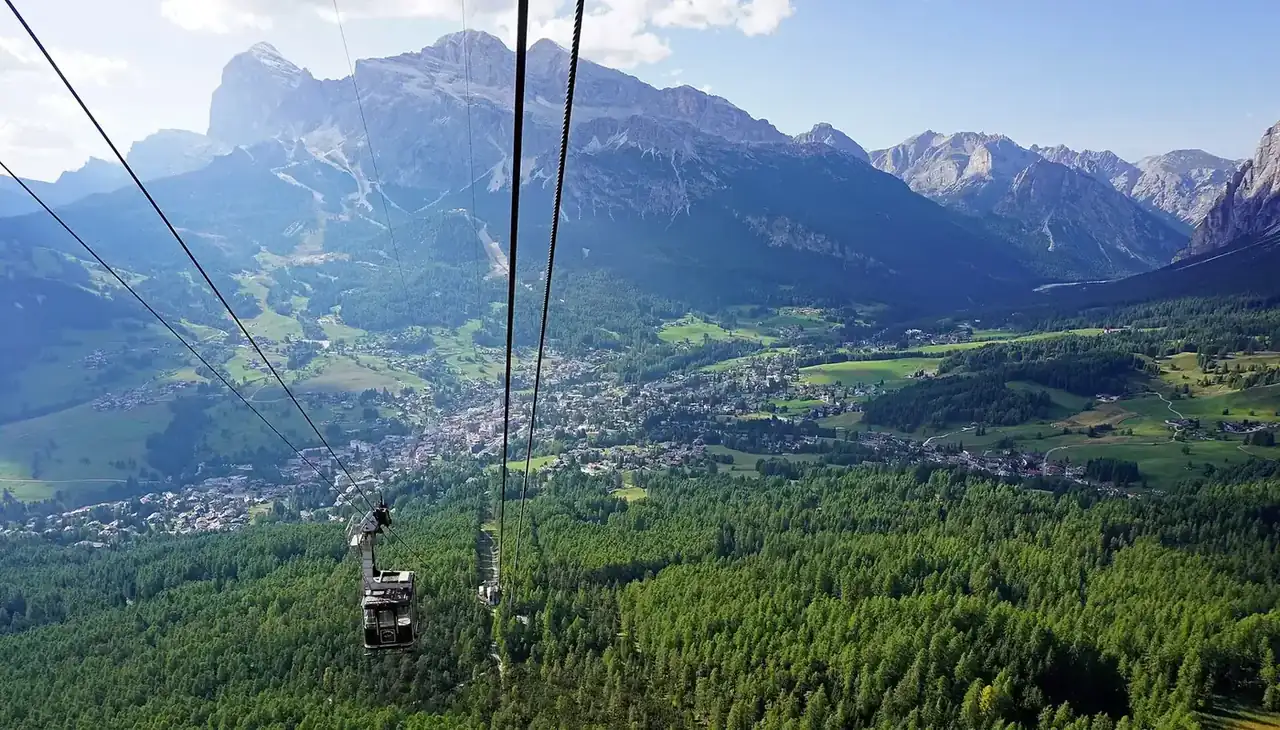
SkiCortina guide
Cortina ski pass: valley or Dolomiti Superski
How the Cortina valley pass differs from a full Dolomiti Superski pass, and how to buy one without trusting a stale price.
kallerna, Wikimedia Commons, CC BY-SA 4.0

On this page

Buy the pass that matches the map you will actually ski. Cortina sells two ideas under similar names, and mixing them up is how a week gets expensive in the wrong direction. The valley pass is for Cortina and the hills the local consortium treats as its own. The Dolomiti Superski pass is for all twelve valleys. Neither one is a promise that every lift is open, and neither one has a price that belongs on a page like this. The official shop is the price.
What the valley pass covers
The Cortina tourism board describes the valley pass as valid across Cortina d’Ampezzo, including the Skyline gondola and Lagazuoi down toward Armentarola, plus San Vito di Cadore and Auronzo–Misurina. It puts that terrain at 120 kilometres. The same page describes the Cortina ski area itself as 66 slopes served by 26 lifts. Dolomiti Superski’s live Cortina board lists 33 lifts for the consortium. Use those figures as a picture of the product, then trust the live board on the day. A closed lift is closed whether your pass is local or super.
Day passes and multi-day passes up to seven days can be bought at lift departures. Longer multi-day passes and season passes are issued at the skipass office or online. That split matters on a Sunday evening when you want eight days and the booth at the cable car will not sell them. The visitor office on Corso Italia is the place to ask where this week’s skipass desk actually is. The phone published on the lifts page is +39 0436 869086.
A My Dolomiti Card is a personal, reusable card you load with either the valley pass or the full Superski pass. Order it through the Dolomiti Superski site, pick it up once, and after that you can reload online and walk to the turnstile. If you do not have the card, an online purchase produces a QR code you exchange at a ticket office or a pickup box. The tourism board also describes a small discount for buying online ahead of the valid day. Read the current rule on the shop before you count on a percentage. Promotions move. The card itself is not a pass. It is the plastic the pass lives on.
Children, juniors, and older skiers get reductions, and accompanied children can be free, under rules the consortium republishes with new birth years. Copying a cutoff from a 2024 article will not get a child through a gate in 2027. Look at the age bands on the day you pay. One accompanying adult, one free child, identification, and both of you present: that is the shape of the rule the valleys have used, and the exceptions for season passes are real. Confirm it. Do not argue with a cashier from memory.
| Cortina valley pass | Dolomiti Superski | |
|---|---|---|
| Best for | A week on Cortina's own mountains | A day that continues into Alta Badia or another valley |
| Covers | Cortina, the Skyline, Lagazuoi toward Armentarola, San Vito, Auronzo, and Misurina | All 12 Dolomiti Superski valleys |
| Does not | Open the Sella Ronda or Val Gardena by itself | Create a ski track from Cortina to Selva |
What the full Dolomiti Superski pass adds
Dolomiti Superski describes the network as twelve ski areas and over 1,200 kilometres of slopes in the UNESCO Dolomites, with one pass. Its areas page shows about 450 lifts. The twelve are Cortina d’Ampezzo, Kronplatz, Alta Badia, Val Gardena / Alpe di Siusi, Val di Fassa / Carezza, Arabba / Marmolada, the 3 Zinnen Dolomites, Val di Fiemme / Obereggen, San Martino di Castrozza / Passo Rolle, Gitschberg Jochtal / Bressanone, Alpe Lusia / San Pellegrino, and Civetta.
The pass is how you ski the Sella Ronda and the First World War ski tour. It is also how an Ikon Pass holder may ski here. The consortium FAQ says an Ikon Pass can include Dolomiti Superski. Blackout days and the number of days are Ikon’s rules, not ours. Read them on Ikon’s site before you fly.
The FAQ is equally clear about geography. Not every resort is reachable on skis. Some connections are a paid bus or a train. From Cortina, the romantic version of “one pass, endless skiing” is the Lagazuoi cable car, the red run to Armentarola, the paid horse-drawn pull into Alta Badia, and then a bus or taxi home. Do that once, on a bluebird day, with the areas guide open. Do not buy the super pass for a three-day weekend and then feel you wasted it because you skied Faloria twice and liked it.
A week that stays on the Tofane, Faloria, Cristallo, and Cinque Torri is a valley-pass week. A week that includes a day in Alta Badia or a comparison trip toward Val Gardena is a Superski week. The valley pass will not open Selva’s lifts. The Superski pass will not create a ski track that is not there.
Rules that sit on top of either pass
The pass is strictly personal. You cannot hand it to a partner for the afternoon, even if you are tired and they are not. Gate cameras can check. The consortium says misuse can mean the pass is withdrawn or cancelled.
Insurance is separate. Since 1 January 2022, Italian ski areas require third-party liability cover for damage to other people. It is not in the pass. You do not have to show it to buy the ticket. You do have to show it if the police ask, and skiing without it can mean a fine and a withdrawn pass. Buy a policy you understand, from an insurer who will actually answer, before you are standing in boots. Travel insurance that says “sports” in the brochure is not automatically this policy. Read the clause.
A helmet is mandatory from the 2025/26 season for everyone, of any age, practising skiing, snowboarding, telemark, freestyle, or tobogganing. The school will not lend you a personality. A shop will rent you a helmet, and the gear page has one you can own if you would rather not roll the dice on a rental stock in February. The pass does not include one.
Pedestrians may ride gondolas and cable cars. Walking on a piste is forbidden. Not every chairlift will take a person without skis. If someone in the group is not skiing, point them at Faloria, the Tofane cable car, or Lagazuoi, and check the pedestrian rule on that lift the same morning. Summer opening times are a different product. The winter board is the winter board.
The official winter season, in the consortium’s words, begins with the opening of the Sella Ronda. Some Cortina lifts are posted earlier. The Cortina board’s season window for 2026/27 is 28 November 2026 to 2 May 2027, and plenty of lifts inside that window have shorter dates. A pass valid “all season” does not spin a cable car that has closed for wind. The best time page lists the posted windows. The live page is the one you refresh on the phone at breakfast.
Buy online if the discount still exists when you look, pick the card up or use a box, and keep the receipt until the first gate accepts you. Then stop thinking about the pass and go skiing.
Questions people actually ask
Does one pass ski every valley on skis?
The Dolomiti Superski pass is valid in all 12 ski areas. The areas are not all joined by runs. Dolomiti Superski says some links are by paid bus or train, including parts of the First World War ski tour. From Cortina, Alta Badia is a ski-and-transfer day via Lagazuoi and Armentarola, not a free ride from the hotel door.
Is a helmet included, or insurance?
Neither. From the 2025/26 season a helmet is mandatory for every age on skis, a snowboard, telemark, freestyle gear, or a toboggan. Since 1 January 2022 everyone needs third-party liability insurance, and the pass does not include it. You may be fined, or have the pass withdrawn, if you ski without cover.
Can I share a pass?
No. The pass is personal. It cannot be given to someone else, even free of charge. Gates can check use with cameras. Misuse can mean the pass is withdrawn. Buy the right age band on the official shop. Birth-year cutoffs change, so do not copy last winter's rule from a blog.
Sources checked
Updated 15 November 2026. Official pages win if a detail here and a live lift board disagree.